

Program management that tests every change before you commit
Rate changes, ramps, and work transfers can hit 20,000 part numbers down the BOM. Pelico traces every move through each line and plant, so you know how to keep up.
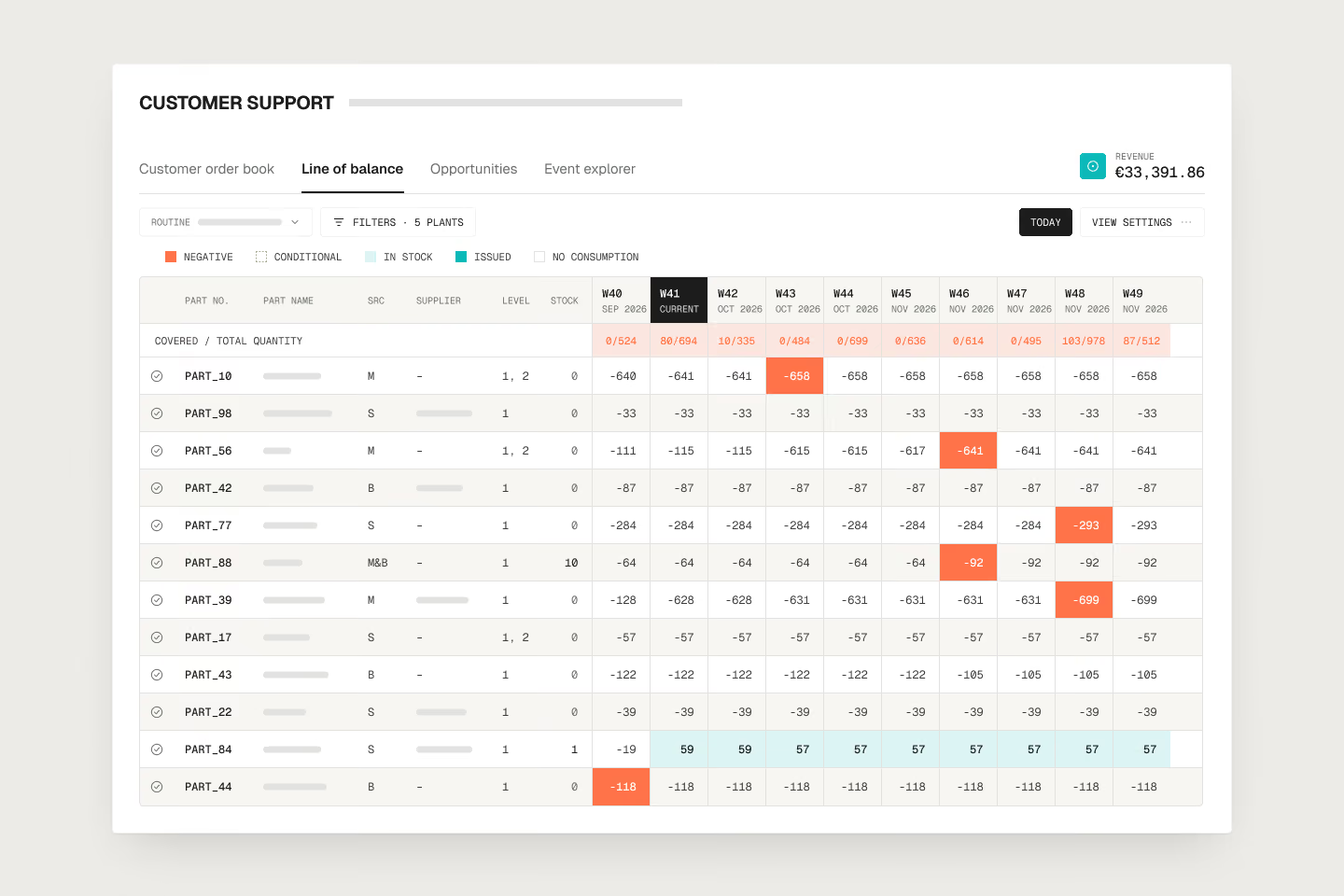
What changes with Pelico
Results from customer deployments:
On-time delivery
+15%
Material coverage
+29%
Productivity
+72%
Go live
12 wks
Why program status is always one step behind

The rollup is manual
How old are the numbers in your weekly program review by the time leadership reads them?
Rate changes reach further than anyone can trace
When a rate change comes in, how far down the BOM can your team price it before it's approved?
Cross-site decisions live in meetings, not in a system
When two plants make a trade-off on a program, where is the decision recorded?
CAPABILITIES
What Pelico gives program leaders
The Program Management solution runs on Pelico's Manufacturing Orchestration Platform. It's every program on live ERP, MES, and planning data across every plant, with each rate change, ramp, or transfer tested before you commit.
Made for: Master Planners · Program Directors · Supply Chain Directors · VPs of Operations
Cross-site program health
Program health for every plant running the program, built from ERP, MES, and planning data instead of manual extracts.
Rate-change and ramp simulation
Model a rate change, ramp-up, or ramp-down through the full BOM, against real capacity and material. Each option is scored on OTD, margin, and supplier continuity before you commit.
Cross-site decision record
Every trade-off between plants on an owned ticket, with what was decided, by whom, and why, so the next review starts from the record.
Work transfer between plants
Sequence what moves first, what stays at the source, when validation completes, and when the new line goes live. Capacity at both plants is simulated, not assumed.
AI that can catch a slip in any program, at any plant
Pelico's AI agents trace each late part to the programs it holds up, flag the program starting to slip before the weekly rollup would, and help chase the suppliers behind it.
FAQ
Push the new rate through every level of the BOM and every plant that builds against it, then check each affected part against capacity, stock, and open supplier orders. By hand, that work is slow enough that the assessment often stops at the first level, and misses the supplier that can't keep up. Pelico models the full cascade of a rate change or ramp-up on live data and compares each option against on-time delivery, margin, and supplier continuity.
Sequence it: what moves first, what stays at the source, when validation completes at the destination, and when the new line goes live. Then check capacity and material at both plants for each step instead of assuming them. Pelico simulates the transfer across both sites against open orders, so the sequence is tested before anything moves.
A PMO tool governs the program: milestones, budgets, risks, and reporting. An orchestration platform works underneath it, on the work orders, parts, and capacity at each plant that decide whether those milestones hold. Pelico runs that layer on live data and leaves program governance in the PMO tool.
A control tower reports status: what's late, where, and by how much. Managing a program also takes knowing what a slip does downstream, and getting plants, procurement, and the program team to agree on a response. Pelico models the impact through the BOM and coordinates the response across sites, with a record of what was decided and why.
Know what the next rate change costs
Ask how multi-plant manufacturers use Pelico to price a rate change before they commit, and what it would take across your plants.

