Manufacturing orchestration is an approach to execution that expects constant change
Plans assume stability. Reality is messy: a supplier slip, a quality hold, a ramp-up, each one cascading across BOMs, sites, and teams.
With manufacturing orchestration, operations keep pace in real time. Teams know the full impact of each disruption, coordinate the response, and make the right call before a delivery slips.
the problem
How to know if you have an execution gap
Right now, somewhere in your operation, the plan and reality have already drifted apart. That's the execution gap: the space between the plan and what's actually happening. It plays out in the 0–90 day horizon. Supply is already committed, and every disruption hits the floor. Planning harder won't close the gap.
In the numbers, on-time delivery is low, WIP is high, clear-to-build rates are unstable, and MRO turnaround time runs long. Day to day, it looks like this:

SYMPTOM 1
Hidden impact
When a PO slips, does everyone know which work orders it holds up? Which customer orders sit behind them, across how many BOM levels and sites?
Getting the answer usually means reconciling three ERPs and a dozen spreadsheets by hand. By the time the full picture is ready, it's already out of date.
SYMPTOM 2
Slow recovery
Supply, production, and quality each use their own version of truth. Coordination runs through email threads, calls, and meetings. Fixing one constraint creates another.
Everyone is working hard, but escalation meetings take hours, and a coordinated response plan takes a full week to align on.
SYMPTOM 3
Blind trade-offs
Leadership looks at last week's reports and listens to the loudest voice in the room to make a call.
It's hard to tell what's truly at risk, or what protecting one program costs another. There’s a nagging feeling that you’re about to be blindsided.
What is manufacturing orchestration?
Manufacturing orchestration is an approach to operations execution that treats disruption as the normal state, not the exception. When something slips, teams know what it breaks, coordinate the response, and make the trade-offs before a delivery is at risk.
the solution
Pelico is the Manufacturing Orchestration Platform for complex supply chains and multi-level BOMs
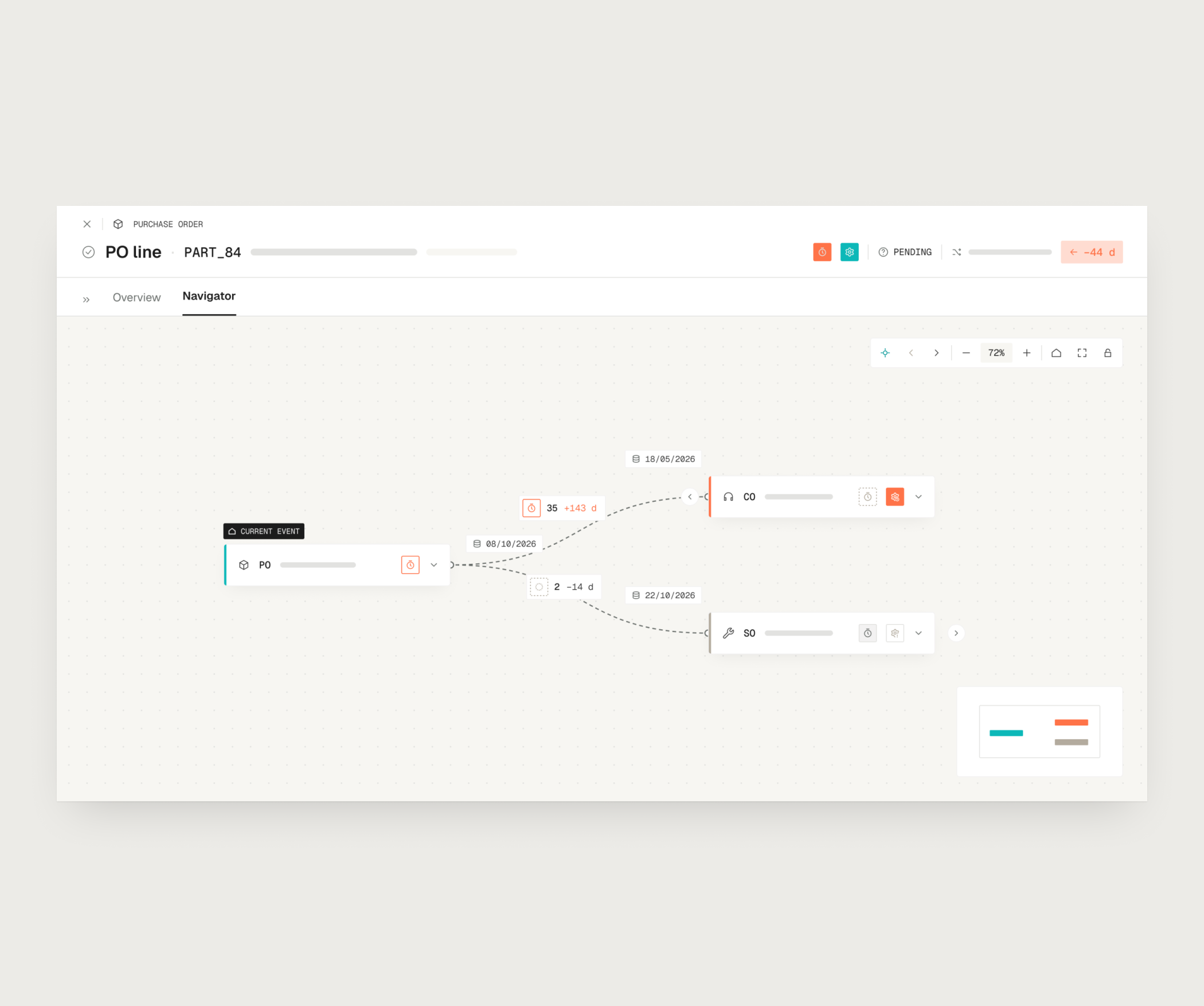
With discrete manufacturing logic built in, the platform runs on live data from existing sources. It maps dependencies through BOMs, suppliers, and sites, so teams stay in sync and the trade-offs are always clear.

The missing layer
Where manufacturing orchestration sits
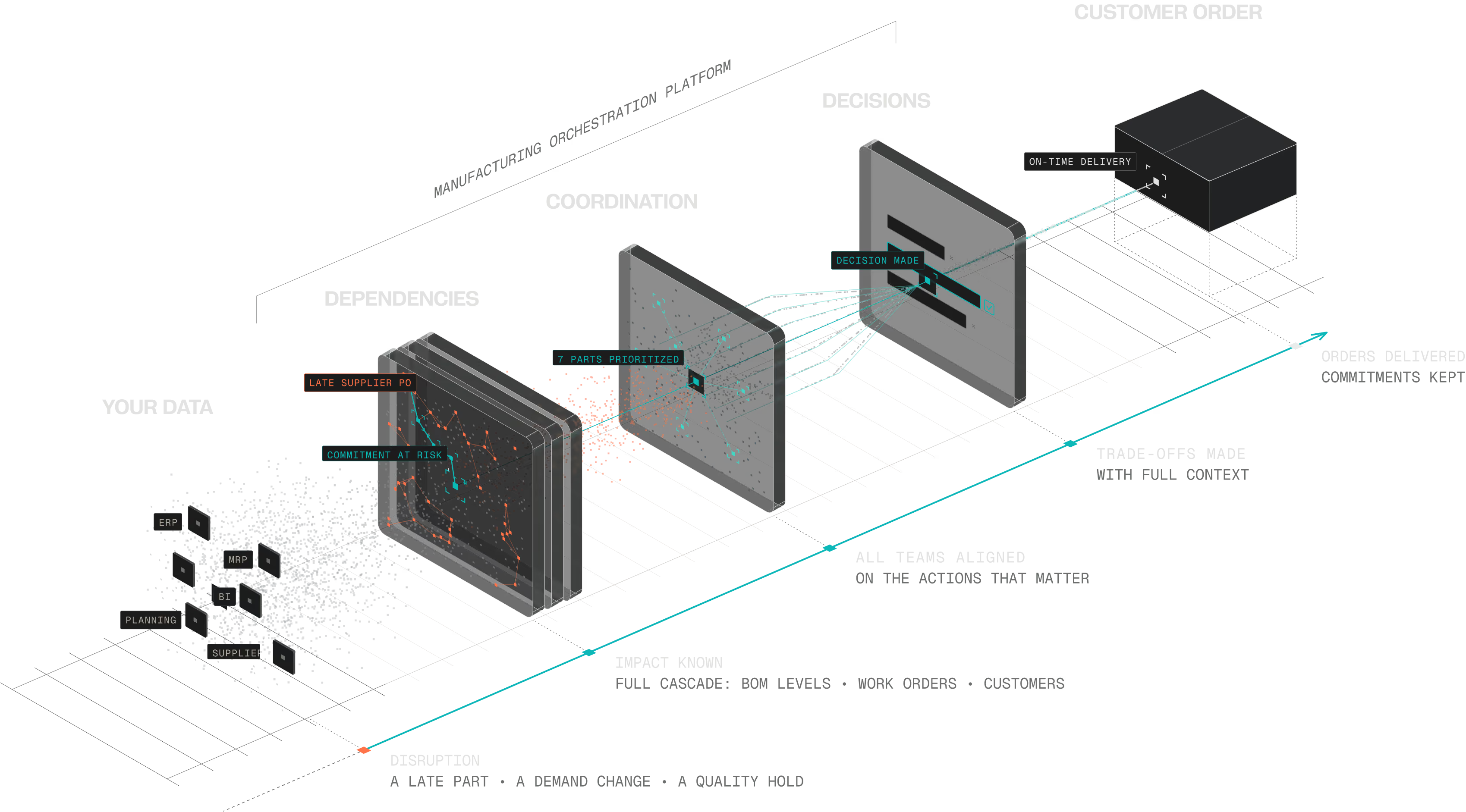
ERP holds the records. Planning systems set the course. MES runs the line. BI reports what already happened. None were built to trace the disruptions that ripple through the next 90 days — or tell you how to keep delivery on track.
What to look for in a manufacturing orchestration platform
dependencies FROM SUPPLIER TO CUSTOMER
A slipped PO shows every work order, site, and customer order it touches, across BOM levels and supplier tiers. No spreadsheets needed to bridge systems.
ONE RESPONSE PLAN ACROSS TEAMS
When a disruption hits, planning, purchasing, supply, production, quality, and customer service see the impact at the same time. Escalations happen right where the work is, and every team follows one path to recovery, with an owner on every step.
CLEAR TRADE-OFFS
Leaders see what's at risk, size the impact of each option, and know what protecting one program costs another.
AI AGENTS THAT PREPARE THE NEXT MOVE
Agents trace each disruption and propose ranked actions inside the workflow. People approve before anything reaches a system of record.
BUILT FOR MANUFACTURING
Multi-level BOMs, pegging, rework, MRO, and multi-site networks on day one, on top of the systems you already run.
The story of one late part, when operations are orchestrated
WITHIN MINUTES
A supplier pushes a $40 bracket by nine days. The team sees how the PO reaches 23 work orders at two sites and three customer orders, through four BOM levels.
WITHIN THE HOUR
Purchasing presses the supplier for a partial shipment, production pulls forward work that doesn't need the bracket, and customer service prepares the at-risk customer for a new date.
before the review
Two of the three customer orders still ship on their original dates. Leadership sees what saving the third would cost and makes the call.
Global manufacturers and MRO providers use Pelico to achieve:
On-time delivery
+15%
MRO turnaround time
-42%
productivity
+40%
part shortages
-37%
Built for
Production Controllers
Planners
Master Planners
Program Managers
Buyers
Supply Managers
Customer Support
FAQ
Pelico is a Manufacturing Orchestration Platform. Manufacturing operations management software and MES record and execute work at the plant and machine level. Pelico sits above them and coordinates the decisions across supply, production, quality and maintenance when reality moves.
Planning systems build an optimized plan and assume it holds. Execution management software runs the 0–90 day window where it does not. Pelico is the execution layer, and most customers run both.
No. Pelico reads live data from your ERP — SAP ECC and S/4HANA through a native extractor, other sources through file and data lake ingestion. Then it pushes actions back into the ERP. APIs cover MES, planning, and quality systems. Transactional records stay where they are.
A data platform harmonizes your data and leaves the decision to you, because the manufacturing logic has to be built case by case. Pelico arrives with that logic in place: supply-to-demand pegging through every BOM level, live clear-to-build status, and the trace from a late part to the customer orders at risk.
Every plant and ERP feeds one model, so a part in one system is linked to the orders it covers in another.
Pelico has a Projection Engine built into the platform that pegs every unit of supply to the demand it covers, through every BOM level. When a purchase order slips, it recalculates the start of every work order consuming that part and the ship date of every customer order behind them, in one pass. You see which deliveries are at risk while there's still time to expedite, reallocate, or reschedule.
A generic copilot is prompted over a general model. Pelico's AI agents run on the platform's manufacturing logic and carry out defined steps. Nothing is written back to a system of record without approval, and every update is scoped and traced.
Around 20 hours in total, from one data and IT referent. They grant ERP access and handle the network side: IP allowlisting, VPN, and SSO. Pelico's team maps your data and sets up the daily refresh.
Yes. Pelico can run on premise, in your own Azure, AWS, or GCP tenant, or in government and sovereign clouds. Air-gapped environments are supported. An on-premise deployment has the same features as the cloud version, and you control the upgrade schedule.
Ready to go from firefighting to flow?
See how Pelico orchestrates real-time execution across complex production environments.

