

Agentic Orchestration for complex supply chain management
Protecting delivery at today's volumes means more routine work than any team can keep up with. Pelico's AI agents take on that work from live operational data, so planners and buyers spend their time on the decisions only they can make.
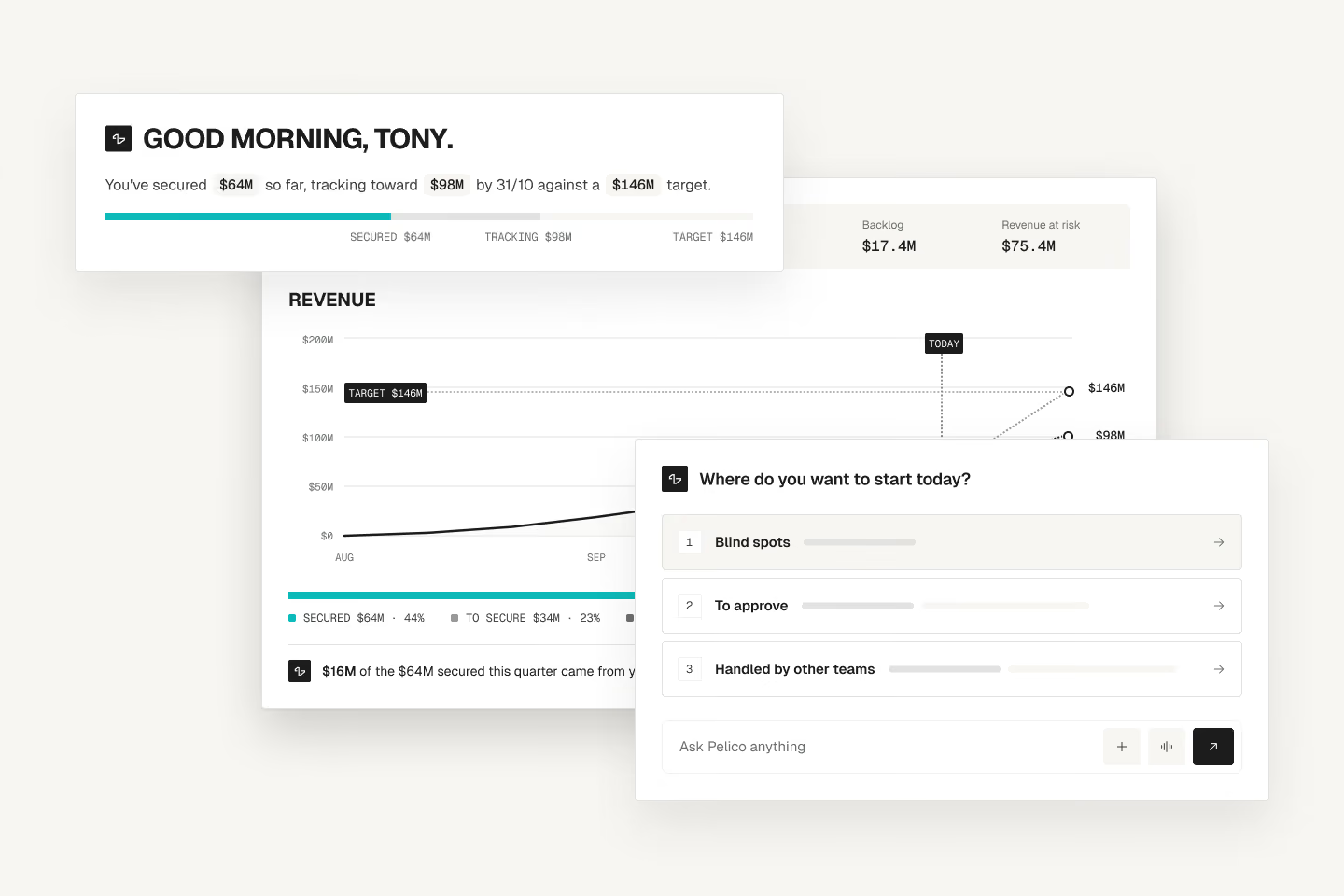
What changes when AI agents take on the routine work
Buyers get hours back
Supplier follow-up and triage stop eating the day
Nothing waits in an inbox
Each exception reaches its owner with the context
Decisions come with reasons
Every recommendation shows what it weighed
The same team handles more
Capacity grows with the workload, not the headcount
Why most AI stalls before it reaches execution

Generic AI doesn't know your operation
Can your AI assistant tell you which orders a late part puts at risk?
A recommendation with no reasoning gets ignored
Would you act on a ranked list you can't trace back to the data?
Bolt-on AI is one more system to check
Would your team rather open yet another tool, or get recommendations in their existing workflow?
CAPABILITIES
How Pelico's AI agents get to work
Agentic orchestration brings Pelico's AI agents into every Pelico solution. They run on the Manufacturing Orchestration Platform and work from live status, multi-level BOM propagation, prioritization logic, and simulation.
Made for: Planners · Buyers · Supply Chain Directors · Production Directors · Continuous Improvement Leads · IT and AI Architects · VPs of Operations
Detect
An AI agent picks up the disruption in live data: a late PO, a quality hold, a shortage, a scope change.
Understand impact
The AI agent traces the disruption through every BOM level to the orders and customer commitments it puts at risk.
Recommend
The AI agent proposes the action with the highest operational impact and shows the reasoning behind it.
Route
The recommendation goes to the person who owns the decision, with the context they need to approve or override it.
Execute
On approval, the AI agent drafts supplier outreach and PO follow-up, handles escalations, and summarizes what changed.
use case
AI agents for procurement, from the first PR to the last receipt
Pelico's AI agents set when each purchase request goes out against the date material is needed, clear stuck ones, draft supplier follow-ups, and rank open POs by the build they hold up. Buyers approve, and confirmed dates go back to the ERP.
Stages the AI agents cover:
- Plan the buy
- Convert or cancel PRs
- Get the PO confirmed
- Manage delivery
- Escalate and resolve
- Close and measure quality
FAQ
With high-volume work that already has clear rules and a clear owner: follow-up on late or unacknowledged POs, shortage triage, and procurement prioritization. The decisions repeat every day, and the data is already in the ERP. Most teams start with one AI agent there, then add the next on the same live model as trust builds.
No. RPA repeats a fixed script step by step and breaks when the screen or the process changes. AI agents work from context: they read the situation, weigh the options, and propose or take the next action. In manufacturing, that context is live order, stock, and BOM data, which is what Pelico's AI agents work from.
It depends on the platform. Ask which models it can run on, where your data goes, and how your AI governance rules apply to its AI agents. Pelico supports customer-approved LLMs, subject to commercial, technical, and security review.
On Pelico's platform, yes. Its AI agents run on an agent development kit: each one is defined by its instructions, tools, triggers, and data scope, so your team can add AI agents with low code or full code, under the same permissions and approval rules.
Three things: what each AI agent can do on its own, where approval sits, and whether every action is logged with its reasoning. Write-back should be scoped per workflow and switched on only where your team has approved it. Pelico's AI agents work within the permissions and guardrails you configure, and every action is auditable.
Ready to put AI agents to work?
Ask how manufacturers use Pelico's AI agents to handle more work with the same team, and what it would take in your plant.

