Agentic AI for manufacturing operations
Your operation generates more signals than any team can track. With Pelico, agentic AI in manufacturing means AI agents that work every signal on a live model of your operation and tee up decisions for your teams.

ai maturity model
Getting to agentic AI
Pelico's maturity model for AI-driven manufacturing runs from spreadsheets to AI agents working alongside your teams. Find where you sit today and what you'll gain at each level.
level 0
Manual
Spreadsheets, homegrown tools, and fragmented data.
The cost: every answer takes hours to assemble.
level 1
Synchronized
Supply, production, and planning work from the same connected data, across every plant.
You gain: hours back from assembling answers, and cleaner ERP records.
level 2
Orchestrated
Teams see disruptions as they happen, anticipate the impact, and coordinate the response.
You gain: the same review cadence across every site.
level 3
AI-assisted
AI simulates recovery options and ranks the actions with the biggest delivery impact.
You gain: recovery decisions backed by projected outcomes.
level 4
AI agent-driven
AI agents monitor, prioritize, and prepare the next action. Your teams set the goals and guardrails.
You gain: on-time delivery without the constant firefighting.
our approach to ai
AI agents inside the workflow, not on top of it
Copilots and generic AI overlays sit beside your systems and summarize them. Pelico's agents run on a live model of how every order, part, and plant connects, so they work each disruption through to an action your team can take today.

grounded in context
When a supplier slips, the AI agents trace it through every BOM level to the delivery it puts at risk.
Goal-driven
A copilot waits for a question. Pelico’s AI agents work toward operational outcomes, like protecting a delivery date, freeing up working capital, or pulling in a late part.
HUMAN-IN-THE-LOOP
AI agents propose prioritized actions. Planners, buyers, and production controllers approve them before they reach your ERP.

AI agents at work in
aerospace
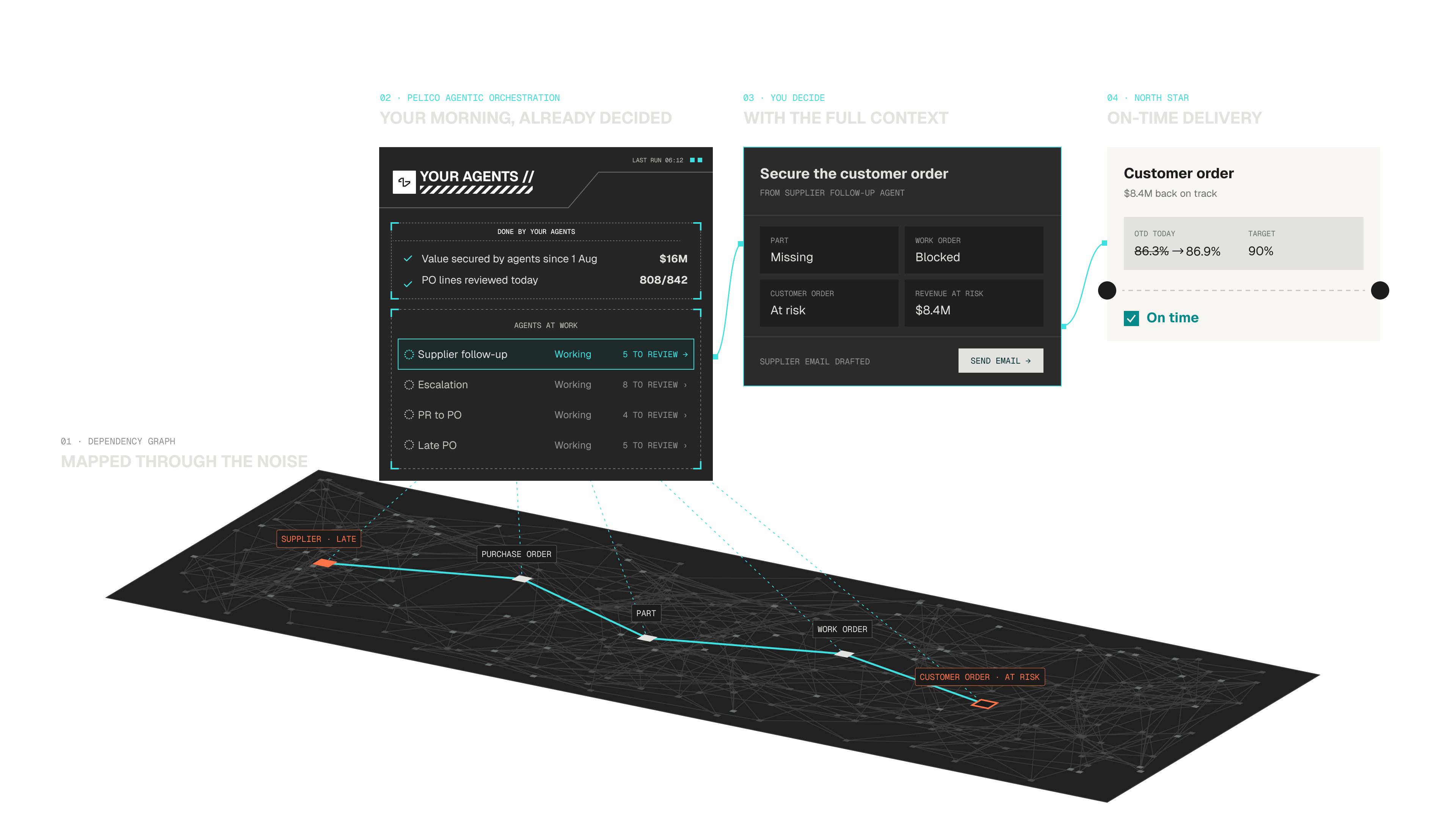
Pelico's AI agents run in production today, triaging the overdue PO book each morning, ranking each line by what it puts at risk, and drafting the supplier follow-ups. Buyers see where each order stands and what's changed, without scrolling through ERP comments.

From a late part to an on-time order
A late supplier date never stays on one PO. Pelico's AI agents trace it through the part and the work order to the customer order it puts at risk, then bring it to the right owner with what's missing, what's blocked, and the revenue on the line. Your team acts before the delivery date slips.
meet the agents
Agentic AI at work in manufacturing
Each AI agent is built for one outcome: reliable supplier dates, shortages caught before they stop the line, stock that matches demand.
Working the buy from PR to delivery
The procurement agent
Sets when each PR goes out, clears stuck ones, and ranks open POs by the build they'll hold up, even before they're past due. Drafts one follow-up per supplier and writes confirmed dates back to the ERP.
Outcomes:
- Smaller past-due PO backlog
- Faster PR-to-PO conversion
- Every late supplier reached each week
Finding the parts that stop the line
The part shortage agent
Ranks shortages by delivery and revenue impact. Lays out the recovery options and their trade-offs, and flags each one to the team that owns it.
Outcomes:
- On-time delivery protection
- Revenue secured on at-risk orders
- Response time compressed from hours to minutes
Turning idle stock into working capital
The excess stock agent
Weighs stock, open POs, BOMs, and demand to find PO deferrals, excess buffers, and WIP to review. Keeps the list ranked, so your planners know what to act on first.
Outcomes:
- Reduced excess and aging stock
- Tighter alignment with real demand
- Freed-up working capital
Keeping every shop visit on its gate dates
The turnaround agent
Predicts when each work order will really finish. Models turnaround time before the scope is fixed, and when a finding or late part puts a date at risk, flags the impact and the recovery options.
Outcomes:
- Earlier warning on late work orders
- TAT held to commitment
- Repair dates customers can count on
What changed for 300+ specialists at one aerospace operation
TIME BACK
+1 hr
per day per specialist
outreach
25 sec
to reach each supplier
(down from 12½ minutes)
clicks
-90%
on routine PO follow-up tasks
How Pelico is built for agentic AI in manufacturing
Manufacturing-native
Pelico’s AI agents run on a model of manufacturing built from the inside, by a team with decades of experience in aerospace and defense, MRO, industrial equipment, and luxury goods production.
Deterministic
Because Pelico pegs every unit of supply to the demand it covers, through every BOM level, the AI agents work from those connections. The calculations behind a recommendation give the same result every time, and planners can trace the chain from a late part to the orders at risk before they approve anything.
Certified
Pelico is a Microsoft Solutions Partner with a certified software designation for Manufacturing AI, an independent validation of interoperability and production-ready deployments.
Governed
Each AI agent has the same access as the role it supports: a buyer's AI agent can do only as much as a buyer can. Every change to a system of record is gated, scoped, and traced, ready for audit in regulated environments.
FAQ
Agentic AI in manufacturing uses AI agents that monitor live operational data, work toward a defined outcome, and prepare the next action for a person to approve. In Pelico, they run on connected ERP, MES, and factory-floor data, so every recommendation reflects how the operation actually runs.
Four high-value agentic AI use cases in manufacturing are procurement, part shortages, excess stock, and MRO turnaround, and Pelico has an AI agent for each. The procurement AI agent sets when each purchase request goes out, ranks open POs by the build they hold up, and drafts supplier follow-ups. The part shortage AI agent ranks shortages by delivery and revenue impact and lays out the recovery options. The excess stock AI agent finds PO deferrals, excess buffers, and WIP to review. The TAT AI agent predicts when each MRO work order will finish and flags dates at risk. People approve before anything reaches a system of record.
A copilot or chatbot responds when someone asks, and works from what your systems already show. Pelico’s AI agents work continuously toward an operational outcome, trace how a disruption spreads through multi-level BOMs, and propose ranked actions inside the workflow. People approve before anything reaches a system of record.
No. AI agents work on the data Pelico already connects from your ERP and other systems of record. If Pelico is live in your plants, that groundwork is done, and getting AI agents running means connecting your LLM endpoint and setting their access.
A new Pelico deployment typically reaches its first plant in production in 9 to 12 weeks, with several days of effort from your IT team. If Pelico is already live, AI agents work on the data you have already connected. What remains is connecting your LLM endpoint, setting AI agent access, and testing the AI agents until they're ready to deploy.
Yes. AI agents run inside your own Pelico environment, which no other customer shares, either on-premises inside your network or in a dedicated instance in Pelico's cloud. They call the LLM endpoint configured for you, including one you host yourself, so the AI processing can stay inside your network. Pelico doesn't train or fine-tune models on your data, and prompts are never used for training. You own your data and everything the AI agents produce.
They can read data, run analysis, and prepare recommendations and drafts. Anything that changes a system of record or goes out to a supplier waits for a planner, buyer, or production controller to approve. The system acts only on what was approved, and every change is traced.
Pelico connects to your ERPs and other systems of record through file and data lake ingestion. AI agents work on that connected data, and actions your teams approve are written back to the ERP with a full audit trail.
No. The numbers can’t be hallucinated. Supply, demand, and BOM dependencies are calculated by rules, not generated by the LLM, so they give the same answer every time. The LLM comes in only where no clean rule exists: reading free text, weighing signals that pull against each other, or drafting a message to a supplier. A person checks its work before it’s used.
Your recovery plan, drafted before you ask
Pelico's AI agents trace each late part to the order at risk, rank the options, and hand your planners a plan to approve. They run on the Manufacturing Orchestration Platform, which connects every plant and system.

