major US aerospace prime
In A&D manufacturing, one disruption can stall an entire program
A late long-lead part, an engineering change, a supplier slip — disruptions cascade through deep BOMs faster than your teams can respond. Pelico surfaces the impact early and coordinates the recovery, so your program dates hold.

Pelico runs inside some of the world's most complex, high-value aerospace and defense programs — from primes to tier 1 and tier 2 suppliers. Names withheld for confidentiality.
leading European aerospace prime
global commercial aero-engine manufacturer
major defense electronics & avionics group
tier 1 aerostructures & systems supplier
More output, fewer shortages, dates that hold
Past aerospace and defense deployments have delivered:
Throughput
+20%
More output from existing capacity, without added labor or CapEx
Part shortages
-37%
Fewer assemblies waiting on a missing part
On-time delivery
+15%
Programs delivered on time more consistently, through earlier detection
The execution gap
An aerospace supply chain disruption doesn't stay contained
In aerospace and defense, the plan and the day-to-day are two different things, and the distance between them is too wide to close with spreadsheets and heroics. That distance is the execution gap: plans are built in systems that assume stability, and executed in conditions that offer none.
Nobody sees how far a slip reaches
A late long-lead part or a mid-build ECO runs through every dependency in a serialized BOM. The full exposure only becomes clear once the date is already at risk.
Three teams, three versions of the truth
Purchasing, production, and engineering each detect the same slip from a different system, at a different hour. Recovery runs on calls and threads.
Decisions land a week late
Trade-offs that should take an afternoon take weeks. By the time the call is made, the date has already moved.
How Pelico orchestrates A&D manufacturing execution
Pelico is the Manufacturing Orchestration Platform that closes the execution gap. It reads what's actually happening across your systems, traces where a disruption lands, and coordinates the response while there's still time to change the outcome.

Every team sees the
full impact
Pelico connects ERP, PLM, supplier portals, quality systems, and the shop floor into one picture. It understands serialized, multi-level BOMs and traces a disruption through every dependency, so purchasing, production, and engineering see the same thing, and material coverage holds for final assembly.
Escalation with a path, not a scramble
When a slip lands, purchasing, production, and engineering work it in the same place, on the same options, instead of across calls and threads. Ownership is explicit, and specialized AI agents take the defined steps while people make the calls, so the line keeps moving.
Leaders know before they're asked
Pelico rolls coverage up by plant, region, and program, so leaders can already say what's at risk, how short they are, and when recovery lands. Not a picture their team spent the morning assembling, and not one that's already stale. It's the difference between defending shortages and driving delivery.
FAQ
Because on-time delivery is counted part by part, but an assembly needs every part. A supplier base at 96% OTD by component count can still mean 0% production coverage if the one missing part goes into every assembly. Pelico tracks coverage at the build level, showing which work orders and program deliveries are fully covered and which part is holding each one back.
The most practical uses take repetitive work off planners and buyers: chasing overdue supplier orders, summarizing PO notes, and preparing recovery options when a part slips. In Pelico, AI agents work from calculated dependencies across serialized, multi-level BOMs, so recommendations reflect how a disruption actually spreads. People approve before anything reaches a system of record.
Yes. Pelico can run entirely on-premise, so controlled program data never leaves your environment. Defense customers run it this way in production. AI agents can run on a model you host yourself, and your data is never used to train one.
Related resources
Pelico news
4
min
read
pelico-news
Pelico Included in Multiple Gartner® Supply Chain Research Publications in 2026

Execution, Not Capacity, Is the Real Bottleneck in A&D
Capacity isn't the constraint — execution is. And most A&D operations haven't fixed it yet.
How an aerospace spare parts operation unblocked $11M in open orders in three months
Every morning, analysts triaged hundreds of live orders across 30+ disconnected tools, with no way to tell which urgent orders were really urgent. Pelico ranked the order book by business impact and moved escalation and supplier outreach into one hub. Live on ERP in 2.5 weeks, it delivered $14M+ in measured impact within a few months.

Predictable MRO Delivery with an Aligned Scheduling and Execution Model
October 14, 2026
text
A Transmission System MRO increases OTD by 15%, decreases WIP by 18%

A Transmission System MRO increases OTD by 15%, decreases WIP by 18%
A Transmission System MRO increases OTD by 15%, decreases WIP by 18%
Pelico news
4
min
read
pelico-news
Pelico Included in Multiple Gartner® Supply Chain Research Publications in 2026

The Value of Factory Agility in the Supply Chain
A guide to the mechanisms of value drivers for complex manufacturers in the aerospace & defense industry
How an aerospace spare parts operation unblocked $11M in open orders in three months
Every morning, analysts triaged hundreds of live orders across 30+ disconnected tools, with no way to tell which urgent orders were really urgent. Pelico ranked the order book by business impact and moved escalation and supplier outreach into one hub. Live on ERP in 2.5 weeks, it delivered $14M+ in measured impact within a few months.
Predictable MRO Delivery with an Aligned Scheduling and Execution Model
October 14, 2026
text
A Transmission System MRO increases OTD by 15%, decreases WIP by 18%

A Transmission System MRO increases OTD by 15%, decreases WIP by 18%
A Transmission System MRO increases OTD by 15%, decreases WIP by 18%
Pelico news
4
min
read
pelico-news
Pelico Included in Multiple Gartner® Supply Chain Research Publications in 2026
Execution, Not Capacity, Is the Real Bottleneck in A&D
Capacity isn't the constraint — execution is. And most A&D operations haven't fixed it yet.
How a leading aerospace MRO shop cut part shortages by 73% during a ramp-up
To leverage its data and simplify its daily routines during a steep ramp-up, this industry-leading MRO shop used Pelico’s Manufacturing Orchestration Platform. Within 11 weeks, it cut part shortages by 73% and WIP by 18%, raised team productivity by 80%, and reached a 97% user adoption rate.
Predictable MRO Delivery with an Aligned Scheduling and Execution Model
October 14, 2026
text
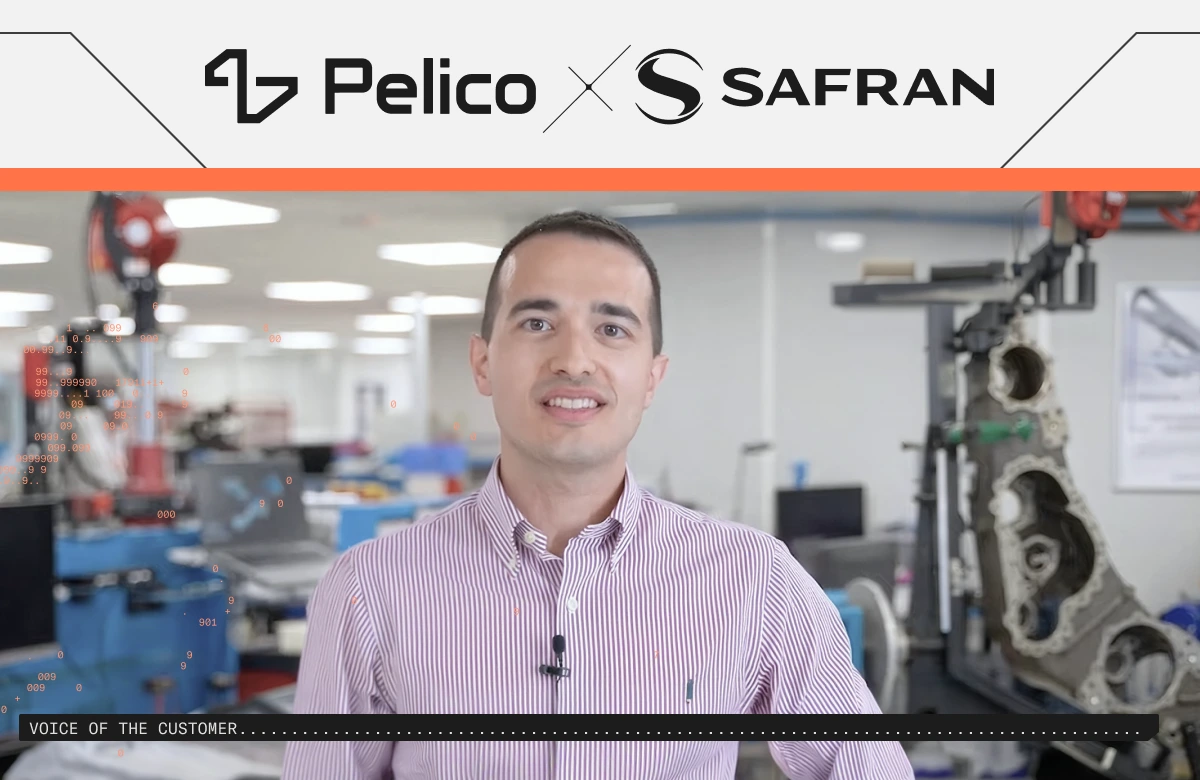
How Safran Transmission Systems reduced parts shortages by 88% thanks to Pelico
Program dates that hold, through every disruption
See how A&D teams use Pelico to protect delivery through ramp-ups.

