

Engine MRO: Protect TAT from induction to release
Shop visit plans rarely survive first inspection. Pelico traces each finding to the TAT it costs, while you can still win it back.
What changes with Pelico
Results from customer deployments:
Engine TAT
−40%
On-time delivery
+15%
Productivity
+72%
Go live
12 wks
Why repair cycles slip

Findings change the workscope after the plan is set
How long until you know what a new finding does to the TAT?
Every shortage on the kit list looks urgent
Do you know which missing part will cost the most TAT?
Repairs disappear into the vendor loop
Do you have a return date for every part out at a vendor or offload shop?
CAPABILITIES
What Pelico gives MRO shops
The Engine MRO solution runs on Pelico's Manufacturing Orchestration Platform. It ties every finding, kit, and part to the shop visits waiting on them, and to the TAT each one puts at risk.
Made for: Shop Visit Managers · Kitting Managers · MRO Supply Planners · Master Schedulers · VPs of MRO Operations
Clear-to-repair and kit readiness
Track coverage status, missing parts, and line of balance for every kit, with a readiness signal before induction. The shortage holding up the most TAT comes first.
Induction and TAT management
Decide to induct, defer, or induct with risk against live shortages and TAT exposure, then simulate the TAT as findings change the workscope.
MRO inventory and alternates
Check stock and approved alternates against every shop visit that needs them. When a part is short, know which shop visits it holds up before you allocate it.
Repair loop tracking
Track a projected return date for every part out at a vendor or offload shop, tied to the engine and gate waiting on it. Returns that will miss the kit date get flagged early.
Shop visit portfolio and performance analytics
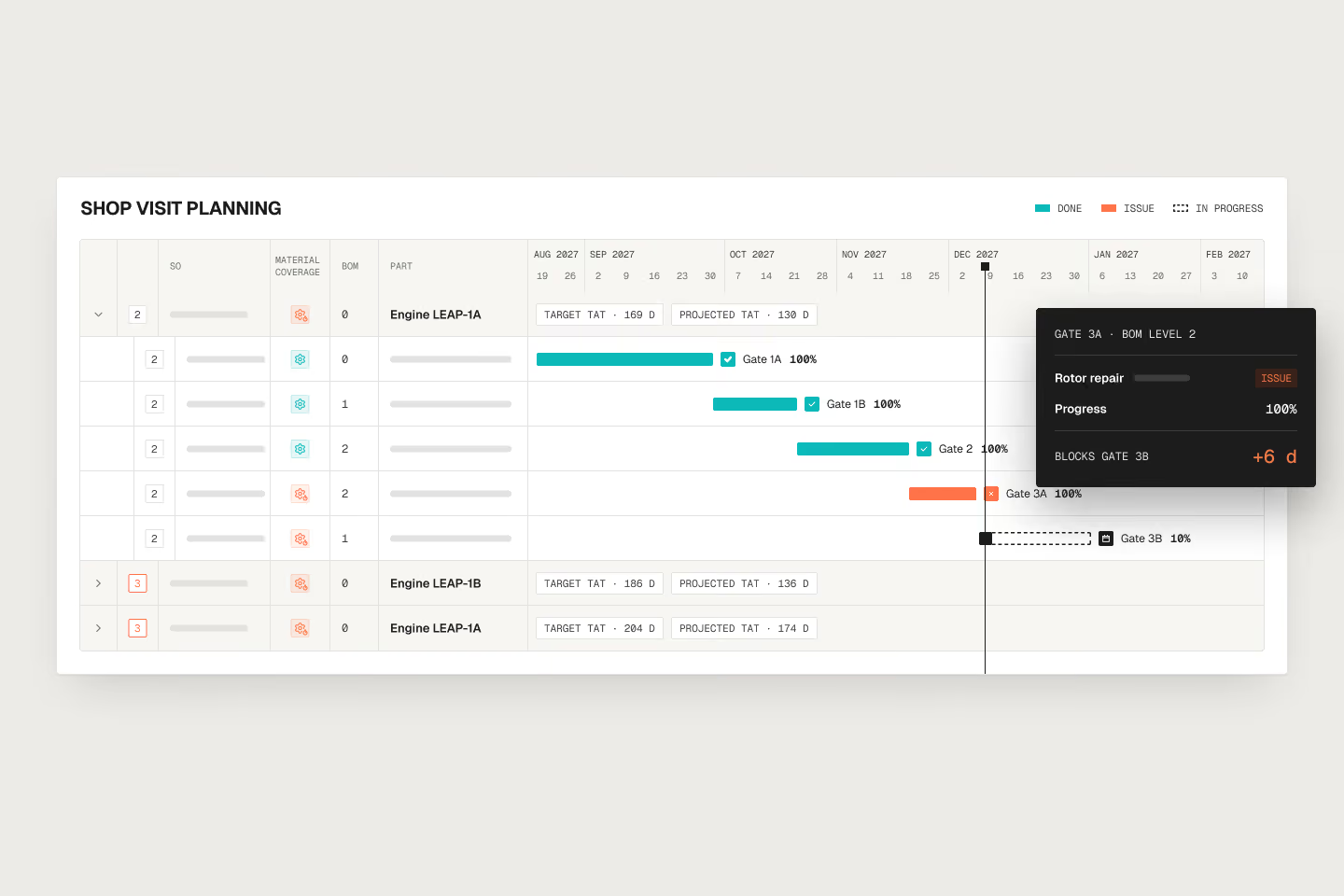
Follow every shop visit in the Gantt view, and cluster root causes across the portfolio so recurring delays get named and fixed.
AI built into the shop visit
Pelico's AI agents follow each inspection finding to every kit and shop visit it touches, across the whole portfolio, and help chase suppliers by drafting the follow-up.
FAQ
Peg every part the work scope needs, including repairs still in the loop, to the module and engine it goes into, and track coverage daily rather than at the gate. Rank what's missing by the TAT it holds. Pelico does this from SAP and the MES, so the kitting manager sees what's missing for each engine in seconds.
Tie each finding to the parts, repairs, and gates it adds. Then re-date the shop visit against what's actually in stock and in the repair loop, and give the customer one revised date rather than a string of slips. Pelico recalculates the shop visit's TAT from each finding, so the new quote rests on parts and gates, not a padded buffer.
Check each short part's expected arrival against the gate that needs it. If every part lands before its gate, inducting now protects the slot and the customer date. If one won't, the engine sits disassembled waiting, and deferring is usually the better call. Pelico runs that check for every engine in the queue, so you can induct, defer, or induct with risk on real dates.
Give every subcontracted repair a projected return date, even when the vendor hasn't committed to one, and tie it to the engine and gate waiting on it. At that scale, historical lead times by vendor are usually the best estimate. Pelico projects returns this way across every shop and flags the ones that will miss the kit date.
A WIP dashboard tracks where each engine is and re-dates the milestones when something slips. An orchestration platform ranks what's blocking each engine by TAT impact, proposes options such as an alternate, and gives every blocker an owner. Pelico runs on top of SAP and your MES, alongside the dashboard.
Yes. An engine shop visit has its scope set at teardown, a deep serialized BOM, and one TAT per engine. Landing gear overhauls come in on calendar intervals and move many units through the same gates, so the risk is parts and quotes holding units up. Pelico covers both on the same data: engine shop visits on Engine MRO, and landing gear on Spares and Component Repair.
Cut TAT,
not corners
Ask how one MRO shop used Pelico to reduce turnaround time by 40%, and what it would take in your shop.

