When the Plan Breaks, Someone Still Has to Decide
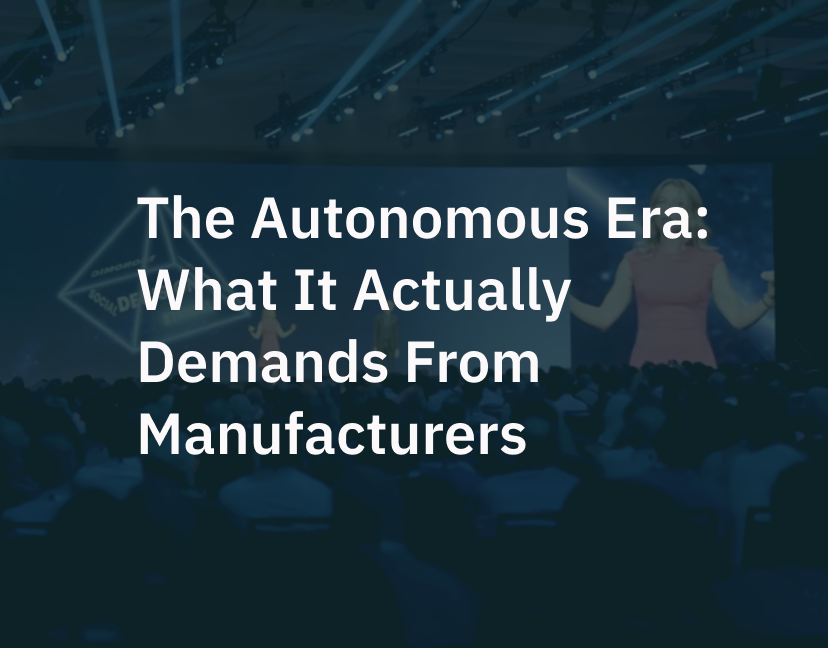
On the main stage at the 2026 Gartner® Supply Chain Symposium/Xpo™ in Orlando, the sessions centered on AI readiness and use case triage. Off-stage, on the show floor, in the analyst hallway, at customer dinners, a different conversation was underway. These are notes from that conversation: what practitioners were actually describing, why orchestration is the idea underneath all of it, and a development that arrived after the symposium, when the category those practitioners were describing received a formal designation.

The off-stage question was never about which AI use case to pilot
While on-stage sessions focused heavily on AI readiness and use case triage, the practitioners we spoke with off-stage were not debating their use case inventory. Instead, they were describing a single recurring morning scenario: a supplier slips, a part does not arrive, a quality hold lands on a critical lot, and the plan that looked solid the night before is suddenly disrupted.
The question they actually live with is simpler and harder than use case selection: when the plan breaks at 6:00 AM, who decides what to do next, and how long does that decision take?
The honest answer, in most plants, is that the decision waits. It waits for the specific planner who understands the network. It waits while someone manually reconciles an export from the planning system against the reality in the execution system, or against a spreadsheet that a supervisor keeps on the side. The cost here is not a missing capability; it is decision latency, measured in hours and days, against a floor that changes by the minute.
The floor needs a decision, not more visibility
Most software sold into this gap promises visibility. Visibility is necessary, but it is not the point. Knowing a part is late is not the same as deciding which order to protect, which plant can transfer stock, and which customer commitment moves as a result.
Planning systems are not the point either. They re-optimize the plan in coarse time buckets on a daily or weekly cadence, which is exactly the wrong resolution for a disruption that happened twenty minutes ago.
This is where orchestration earns its place. The plan lives in ERP. Advanced planning optimizes it in coarse buckets. Execution is where reality diverges from both, continuously. Orchestration is the layer that closes that loop at operational speed: it reads the disruption, propagates the impact across the network, frames the trade-off, and writes the decision back into the systems of record. It sits above planning and scheduling without replacing them.
Pelico is deliberately built for this layer, focusing on manufacturing and production execution depth rather than end-to-end supply chain breadth. That is a narrower place to stand on purpose, because the next fifteen minutes on the floor is where plans either hold or fall apart.
Why determinism matters more once you add AI
AI pilots often struggle to scale because leaders lack the underlying data trust required to act on what a model recommends. This is why off-stage conversations kept circling back to a question of trust: if a system recommends moving a part, can the controller believe the math behind that recommendation every single time?
The answer that practitioners respond to is not more autonomy stacked on top of shaky arithmetic. It is the opposite. The parameters and the impact calculations must stay deterministic and live. The decision criteria, the parts you actually want to steer, are expressed in natural language.
The engine does the math, meaning the language model acts as the interface, not the calculator. A controller can ask a question in plain words and get an answer grounded in the same deterministic calculation each time, complete with the lineage to show its work. This separation makes a recommendation trustworthy enough to act on at speed.
Specialization is the value, not a limitation
The other recurring skepticism off-stage was aimed at generic platforms that promise to orchestrate anything. Manufacturers have been sold horizontal toolkits before, and they have spent quarters on the configuration required to make them understand a standard bill of materials.
The depth that matters comes from manufacturing itself: natively understanding the relationships between bills of materials, work orders, materials, and quality in weeks, not years.
The model that holds up in practice is a strong, industry-agnostic foundation, plus a thin customer-specific overlay and targeted enhancements. The foundation does most of the work, but specialization is what earns trust on the floor. An orchestration system that does not speak the plant's language natively will not be allowed near the plant's decisions. The moat here is industry DNA and decades of manufacturing experience, not a clever interface laid over a generic core.
Now it has a name to put on the budget line
For a few years, orchestration lived mostly in hallway vocabulary. That is changing, and the symposium turned out to be a leading indicator. Shortly after Orlando, Gartner published its Hype Cycle™ for Supply Chain Strategy, 2026, named "Supply Chain Orchestration" as a technology, and listed Pelico as a Sample Vendor in that category.
In our view, two things make this worth noting.
First, it signals that the category practitioners kept describing off-stage is now real enough for analysts to track formally, which means the next budget cycle has a name to put on the line item.
Second, what makes the inclusion meaningful for us is the place we chose to stand: Pelico is built specifically for manufacturing and production execution, the layer where plans meet the floor. We read the recognition as validation of the category, and of execution depth as a distinct and defensible position, not as a ranking, an award, or an endorsement.
The bottleneck to the autonomous era is the operating model, and orchestration is the part of the operating model that decides and acts when the plan breaks. The manufacturers who pull ahead will be the ones who stop asking which use case to pilot next, and start asking how fast they can make decisions when reality moves. That question has an answer, and it lives on the floor.
Attribution and disclaimer
Gartner, Hype Cycle for Supply Chain Strategy, 2026, Caleb Thomson, 23 June 2026.
"Gartner," "Hype Cycle," and "Supply Chain Symposium/Xpo" are trademarks of Gartner, Inc. and/or its affiliates. Gartner does not endorse any vendor, product or service depicted in its research publications and does not advise technology users to select only those vendors with the highest ratings or other designation. Gartner research publications consist of the opinions of Gartner's research organization and should not be construed as statements of fact. Gartner disclaims all warranties, expressed or implied, with respect to this research, including any warranties of merchantability or fitness for a particular purpose.