
When Strategy Meets Operational Reality: Field Notes from Davos 2026
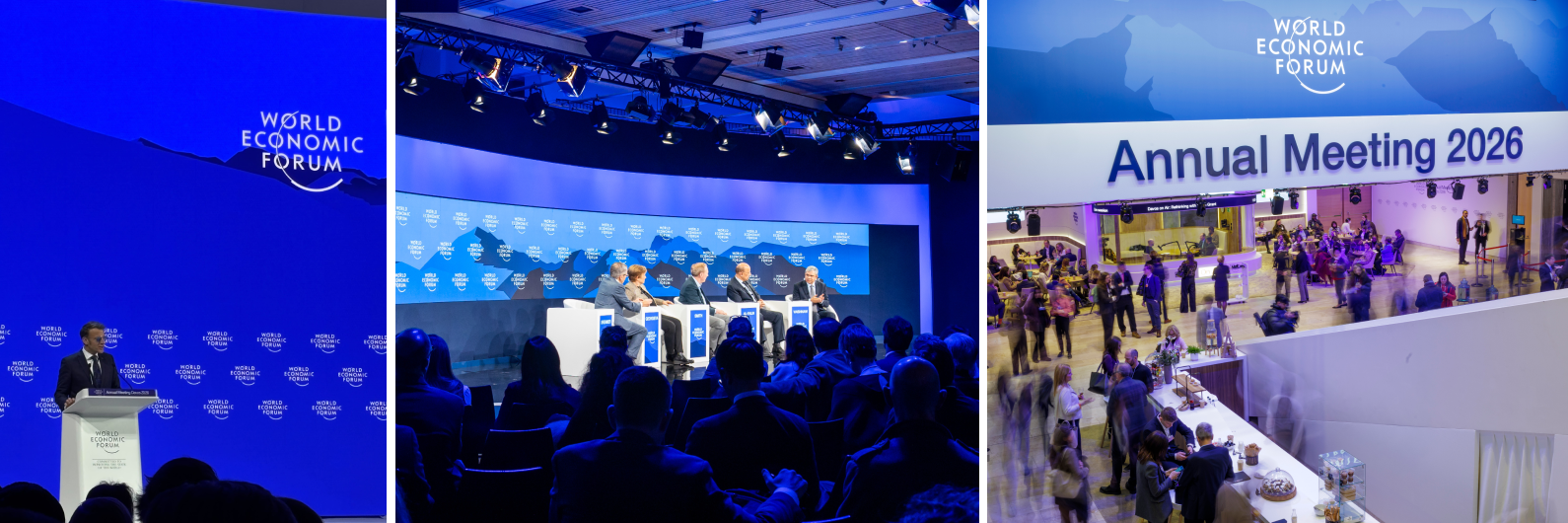
Davos doesn’t invent new dynamics. It brings existing ones into sharper focus.
In Davos with the French delegation, as part of the World Economic Forum’s Global Innovators community, for the 2026 Annual Meeting, I had the opportunity to experience this truth first-hand.
Across conversations with industrial leaders, policymakers, technologists, and operators, a consistent pattern emerged. Ambition is high. Capital is available. Strategic intent is clear. What proves harder, again and again, is execution once conditions start to move.
Not because organizations lack plans, but because the environment those plans operate in has changed in quieter, more structural ways.

Geopolitics Informs Operating Models
The conversations started from a shared premise: geopolitics is no longer a distant backdrop. It actively informs how operating models are designed.
Across discussions, leaders were explicit about what that means in practice. Everyone is optimizing for resilience.
Not as an abstract goal, but as a concrete set of design choices: reducing dependency on single suppliers or regions, protecting critical capabilities, and planning for disruption rather than assuming stability.
This was especially visible in defense, energy, and AI-enabled industries, where operating models are being reshaped to absorb shocks without losing momentum.
Resilience has moved from aspiration to constraint. It shows up under different labels—sovereignty, energy security, defense readiness, supply chain resilience—but the intent is consistent.
As our advisor Eric Enselme summarized during the Forum:
“Success in the AI era will be determined not by isolation, but by strategic interdependence."
At a macro level, this approach strengthens resilience. At an operational level, it introduces new tradeoffs.

Fragmentation Is the Barrier to Resilience
Diversification increases robustness, but it also raises the bar for coordination.
More suppliers. More regions. More regulatory regimes. More partners. The system becomes harder to run, even when it becomes safer to rely on.
What surfaced repeatedly in Davos was not concern about complexity itself. Most leaders accept complexity as structural.
The challenge is fragmentation.
Teams often discover the same issue at different times, through different systems, with different assumptions. By the time alignment is reached, recovery is already expensive. Inventory becomes a hedge against uncertainty. Buffers grow. Decisions slow.
Fragmentation, not complexity, is what prevents resilience from materializing in day-to-day execution.
The organizations moving faster are not simplifying the world around them. They are simplifying how decisions get made when the world changes.

Energy and Industrial Execution Are Under Sustained Pressure
One of the clearest signals from the week came from the energy ecosystem.
Demand continues to rise across grids, electrification, data centers, renewables, and defense-related infrastructure.
Manufacturers are carrying significant backlogs while being asked to scale at the same time.
This is not a planning problem. Funding exists. Demand is visible.
The constraint is execution across capital-intensive, long-lead, multi-tier industrial networks. Late parts, quality holds, engineering changes, and supplier volatility are no longer edge cases. They are routine.
In this environment, the difference between progress and backlog is less about forecast accuracy and more about how quickly teams can detect issues, understand impact, and coordinate response.
In our experience, in many industrial supply chains, disruptions now invalidate plans with striking regularity. A material disruption happens roughly every 16 minutes. As fragmentation increases, this cadence only accelerates, and the window to respond narrows.
At that cadence, no organization can rely on manual coordination alone. Processing signals, assessing trade‑offs, and aligning execution across teams fast enough is simply beyond human capacity without support.

AI Conversations Are Becoming More Grounded
AI was present in nearly every discussion, but the tone has shifted.
There was noticeably less focus on abstract capability and more attention on how systems behave in real operating environments. What happens when models interact with physical constraints, messy data, incentives, and human decision-making.
Trust emerged as a recurring theme. Not as a slogan, but as a practical requirement. As Enselme observed:
“AI adoption now depends on trust—not benchmark performance.”
That trust is built through explainability, auditability, clear governance, and defined decision ownership. Especially when AI is applied to physical systems, these elements quickly become non-negotiable.
This perspective was echoed by Accenture CEO Julie Sweet, who captured the shift succinctly:
“It is human-in-the-lead, not human in the loop.”
The implication is not about slowing AI adoption. It is about anchoring it in operational reality, where decisions carry real consequences.
Operating Models Are Quietly Adjusting
Alongside these structural shifts, a subtler change was evident in how leaders talk about organizations themselves.
There is growing skepticism toward layered hierarchies, excessive process, and progress measured through artifacts rather than outcomes. In their place, leaders described smaller teams, clearer mandates, and accountability pushed closer to execution.
This is not a cultural trend. It is a response to pressure.
When disruption is frequent, speed and clarity outperform precision planning.

Where Strategies Are Being Tested
Taken together, the signal from Davos is not about a single technology or policy direction. It is about where strategies succeed or fail once they meet operational reality.
Resilience, AI adoption, energy transition, and industrial competitiveness all converge on the same capability: the ability to turn intent into coordinated action as conditions change.
Execution is where strategies are being tested.
The hardest work is no longer defining the plan. It is making that plan hold under sustained pressure.

Davos is intense in very practical ways. The schedule is dense, logistics are stretched, and days run long — but it is also a genuinely rewarding experience. The concentration of conversations, perspectives, and signals makes it a valuable moment to step back and compare notes.
It’s a useful reminder that even global discussions about strategy and resilience are shaped by real constraints on the ground, a fitting parallel to many of the themes above.
Photo credit for all images: World Economic Forum.
This might interest you

